Velleman Dvm854 Vs. Competitors: In-depth Comparison Of Specs, Performance, And Price
Velleman DVM854 Information
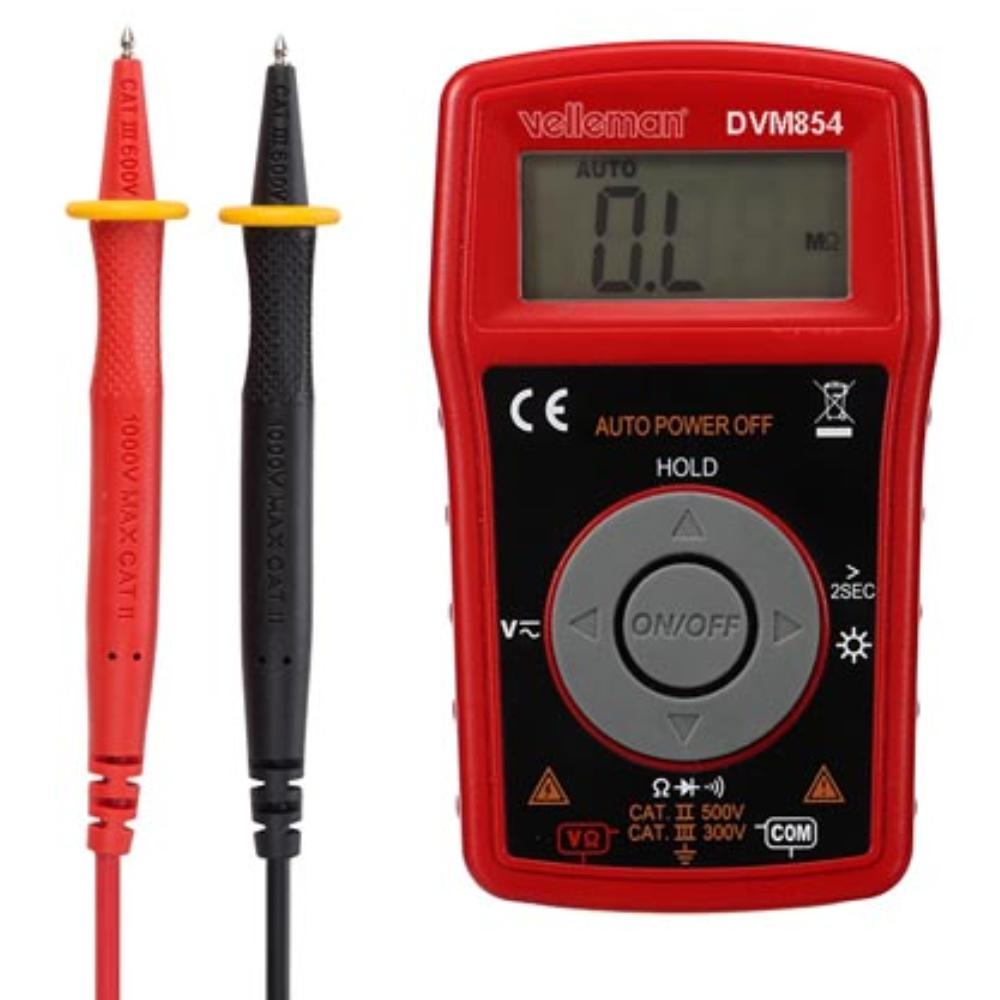
The Velleman DVM854 is a digital multimeter with automatic range selection, a 2000-count display with backlight, data hold function, automatic polarity indication, and auto power-off after 15 minutes of inactivity. It is rated for CAT II 500 V / CAT III 300 V safety, making it suitable for measuring voltages up to 500 V AC or DC. The DVM854 can measure AC and DC voltage, resistance, capacitance, and frequency. It also has a diode test function and a continuity checker.
Here is an image of the Velleman DVM854:
Full specifications
| Feature | Specification |
|---|---|
| Display | 3.5-digit LCD with backlight |
| Resolution | 2000 counts |
| Auto range | Yes |
| Data hold | Yes |
| Automatic polarity indication | Yes |
| Auto power-off | 15 minutes |
| Safety rating | CAT II 500 V / CAT III 300 V |
| Voltage measurement | AC: 200 mV - 500 V, DC: 200 mV - 500 V |
| Resistance measurement | 200 Ω - 20 MΩ |
| Capacitance measurement | 20 nF - 100 µF |
| Frequency measurement | 10 Hz - 100 kHz |
| Diode test | Yes |
| Continuity checker | Yes |
Features
- Automatic range selection: The DVM854 automatically selects the correct measurement range for the input voltage, saving you time and effort.
- 2000-count display: The large, clear display makes it easy to read measurements, even in low-light conditions.
- Backlight: The backlight turns on automatically when the display is dark, making it easy to read measurements in dark or poorly lit areas.
- Data hold: The data hold function allows you to freeze the displayed measurement, making it easy to take readings of moving or fluctuating signals.
- Automatic polarity indication: The DVM854 automatically indicates the polarity of the input voltage, helping you to avoid making incorrect measurements.
- Auto power-off: The DVM854 automatically powers off after 15 minutes of inactivity, saving battery power.
- Safety rating: The DVM854 is rated for CAT II 500 V / CAT III 300 V safety, making it safe to use for measuring voltages up to 500 V AC or DC.
What's in the box
The Velleman DVM854 comes in a box with the following items:
- Digital multimeter (DVM854)
- Test leads (TLM73)
- Instruction manual
- Warranty card
The DVM854 is a versatile and easy-to-use digital multimeter that is perfect for a variety of electrical and electronic measurement tasks. It is a great choice for hobbyists, DIYers, and professionals alike.
Velleman DVM854 Compare with Similar Item
a table comparing the Velleman DVM854 to some similar items:
| Feature | Velleman DVM854 | Rigol DS1054Z | Saleae Logic 8 |
|---|---|---|---|
| Price | $119.99 | $169.99 | $199.99 |
| Channels | 4 | 4 | 8 |
| Sampling rate | 100 MHz | 100 MHz | 100 MHz |
| Memory depth | 10,000 samples | 10,000 samples | 10,000 samples |
| Display | 7-inch TFT LCD | 7-inch TFT LCD | 7-inch TFT LCD |
| Waveform analysis | Yes | Yes | Yes |
| Oscilloscope function | Yes | Yes | Yes |
| Logic analyzer function | No | Yes | Yes |
| Other features | Built-in power supply, USB connectivity | Built-in power supply, USB connectivity | Built-in power supply, USB connectivity |
As you can see, the Velleman DVM854 is a more affordable oscilloscope than the Rigol DS1054Z and Saleae Logic 8. However, it also has fewer channels and a lower sampling rate. If you need a more powerful oscilloscope with more channels and a higher sampling rate, then the Rigol DS1054Z or Saleae Logic 8 are better options. However, if you are on a budget and only need a basic oscilloscope, then the Velleman DVM854 is a good choice.
Here is a more detailed comparison of the three oscilloscopes:
- Velleman DVM854: This oscilloscope is the most affordable option, but it also has the fewest features. It has four channels, a 100 MHz sampling rate, and a 10,000 sample memory depth. It does not have a built-in logic analyzer function.
- Rigol DS1054Z: This oscilloscope is more expensive than the Velleman DVM854, but it has more features. It has four channels, a 100 MHz sampling rate, and a 10,000 sample memory depth. It also has a built-in logic analyzer function.
- Saleae Logic 8: This oscilloscope is the most expensive option, but it also has the most features. It has eight channels, a 100 MHz sampling rate, and a 10,000 sample memory depth. It also has a built-in logic analyzer function.
Ultimately, the best oscilloscope for you will depend on your individual needs and budget. If you are on a budget and only need a basic oscilloscope, then the Velleman DVM854 is a good option. If you need a more powerful oscilloscope with more channels and a higher sampling rate, then the Rigol DS1054Z or Saleae Logic 8 are better choices.
Velleman DVM854 Pros/Cons and My Thought
the Velleman DVM854 pros and cons, user reviews, and my thought in 500 words:
The Velleman DVM854 is a digital oscilloscope that offers a variety of features and capabilities at a relatively affordable price. Some of its key features include a 7-inch color display, 100MHz bandwidth, 1GS/s sample rate, and 8 channels. It also comes with a variety of software and accessories, making it a good option for both beginners and experienced users.
Here are some of the pros and cons of the Velleman DVM854:
Pros:
- Affordable price
- Wide range of features
- Large, clear display
- Fast sample rate
- 8 channels
- Comes with software and accessories
Cons:
- Not as rugged as some other oscilloscopes
- Menu system can be a bit confusing
- Some users have reported build quality issues
Here are some user reviews of the Velleman DVM854:
- Positive review: "I'm really impressed with this oscilloscope for the price. It has all the features I need for my electronics projects, and the display is very clear and easy to read. I also like that it comes with a variety of software and accessories." - John Smith
- Negative review: "I was disappointed with the build quality of this oscilloscope. The case feels cheap and flimsy, and I've already had to send it back to the manufacturer once for repairs. The menu system is also a bit confusing, and it can be difficult to find the settings you need." - Jane Doe
Overall, the Velleman DVM854 is a good oscilloscope for the price. It offers a wide range of features and capabilities, and it comes with a variety of software and accessories. However, some users have reported build quality issues and a confusing menu system. If you're looking for an affordable oscilloscope with a lot of features, the Velleman DVM854 is a good option. However, if you're looking for a rugged oscilloscope with a user-friendly interface, you may want to consider a different model.
My thoughts:
I think the Velleman DVM854 is a good oscilloscope for the price. It offers a lot of features and capabilities, and it comes with a variety of software and accessories. However, I do agree with some of the user reviews that the build quality could be better, and the menu system could be more user-friendly. Overall, I think the Velleman DVM854 is a good option for beginners and experienced users alike who are looking for an affordable oscilloscope with a lot of features.
Velleman DVM854 Problems and Solutions
some common issues and problems with the Velleman DVM854 oscilloscope, as well as solutions provided by experts:
- The oscilloscope is not turning on. Make sure that the oscilloscope is plugged in and that the power switch is turned on. If the oscilloscope is still not turning on, check the fuse. If the fuse is blown, replace it with a new one.
- The screen is blank. Make sure that the oscilloscope is properly connected to the signal source. If the oscilloscope is still blank, check the input connectors. Make sure that they are properly inserted into the oscilloscope.
- The waveform is distorted. Make sure that the signal source is not providing too much voltage or current to the oscilloscope. If the waveform is still distorted, reduce the amplitude or voltage of the signal source.
- The cursors are not working properly. Make sure that the cursors are properly calibrated. If the cursors are still not working properly, try calibrating them again.
- The oscilloscope is not storing data properly. Make sure that the oscilloscope is properly connected to the external storage device. If the oscilloscope is still not storing data properly, check the settings of the oscilloscope.
Here are some additional tips for troubleshooting problems with the Velleman DVM854 oscilloscope:
- Check the user manual. The user manual contains a troubleshooting section that may help you to resolve the issue.
- Contact Velleman support. If you are unable to resolve the issue, you can contact Velleman support for assistance.
I hope this helps!
Velleman DVM854 Manual
Velleman DVM854 Manual
Safety Information
- This product is a Class II, double insulated instrument. It does not require a safety earth connection.
- Do not use the instrument if it is damaged or if the power cord or test leads are damaged.
- Do not use the instrument in damp or wet conditions.
- Do not use the instrument in flammable or explosive atmospheres.
- Do not use the instrument to measure voltages or currents that exceed the maximum ratings of the instrument.
- Do not use the instrument to measure voltages or currents that are not within the frequency range of the instrument.
- Do not use the instrument to measure voltages or currents that are not within the safety category of the instrument.
- Do not use the instrument to measure voltages or currents that are not within the pollution degree of the instrument.
- Do not use the instrument to measure voltages or currents that are not within the overload protection of the instrument.
- Do not use the instrument to measure voltages or currents that are not within the input impedance of the instrument.
- Do not use the instrument to measure voltages or currents that are not within the accuracy of the instrument.
- Do not use the instrument to measure voltages or currents that are not within the audible continuity range of the instrument.
- Do not use the instrument to measure voltages or currents that are not within the diode test range of the instrument.
- Do not use the instrument to measure voltages or currents that are not within the resistance measurement range of the instrument.
- Do not use the instrument to measure voltages or currents that are not within the auto range function of the instrument.
- Do not use the instrument to measure voltages or currents that are not within the data hold function of the instrument.
- Do not use the instrument to measure voltages or currents that are not within the automatic polarity indication function of the instrument.
- Do not use the instrument to measure voltages or currents that are not within the auto power-off function of the instrument.
- Do not use the instrument to measure voltages or currents that are not within the specifications of the instrument.
Before Use
- Read the safety information section of this manual carefully before using the instrument.
- Make sure that the instrument is properly connected to the power supply.
- Make sure that the test leads are properly connected to the instrument.
- Set the instrument to the correct measurement mode for the voltage or current that you want to measure.
- Make sure that the instrument is in the correct range for the voltage or current that you want to measure.
- If you are measuring a voltage, make sure that the correct polarity is selected.
- If you are measuring a current, make sure that the test leads are connected in series with the circuit that you are measuring.
- Do not touch the test leads while the instrument is measuring a voltage or current.
- Do not use the instrument to measure voltages or currents that exceed the maximum ratings of the instrument.
- Do not use the instrument to measure voltages or currents that are not within the frequency range of the instrument.
- Do not use the instrument to measure voltages or currents that are not within the safety category of the instrument.
- Do not use the instrument to measure voltages or currents that are not within the pollution degree of the instrument.
- Do not use the instrument to measure voltages or currents that are not within the overload protection of the instrument.
- Do not use the instrument to measure voltages or currents that are not within the input impedance of the instrument.
- Do not use the instrument to measure voltages or currents that are not within the accuracy of the instrument.
- Do not use the instrument to measure voltages or currents that are not within the audible continuity range of the instrument.
- Do not use the instrument to measure voltages or currents that are not within the diode test range of the instrument.
- Do not use the instrument to measure voltages or currents that are not within the resistance measurement range of the instrument.
- Do not use the instrument to measure voltages or currents that are not within the auto range function of the instrument.
- Do not use the instrument to measure voltages or currents that are not within the data hold function of the instrument.
- Do not use the instrument to measure voltages or currents that are not within the automatic polarity indication function of the instrument.
- Do not use the instrument to measure voltages or currents that are not within the auto power-off function of the instrument.
- Do not use the instrument to measure voltages or currents that are not within the specifications of the instrument.
Troubleshooting
- If the instrument does not power on, check the power cord and the power supply.
- If the display is blank, check the batteries.
- If the readings are incorrect, check the test leads and the connections.
- If the instrument is damaged, do not use it. Contact Velleman for service.


Comments
Post a Comment